
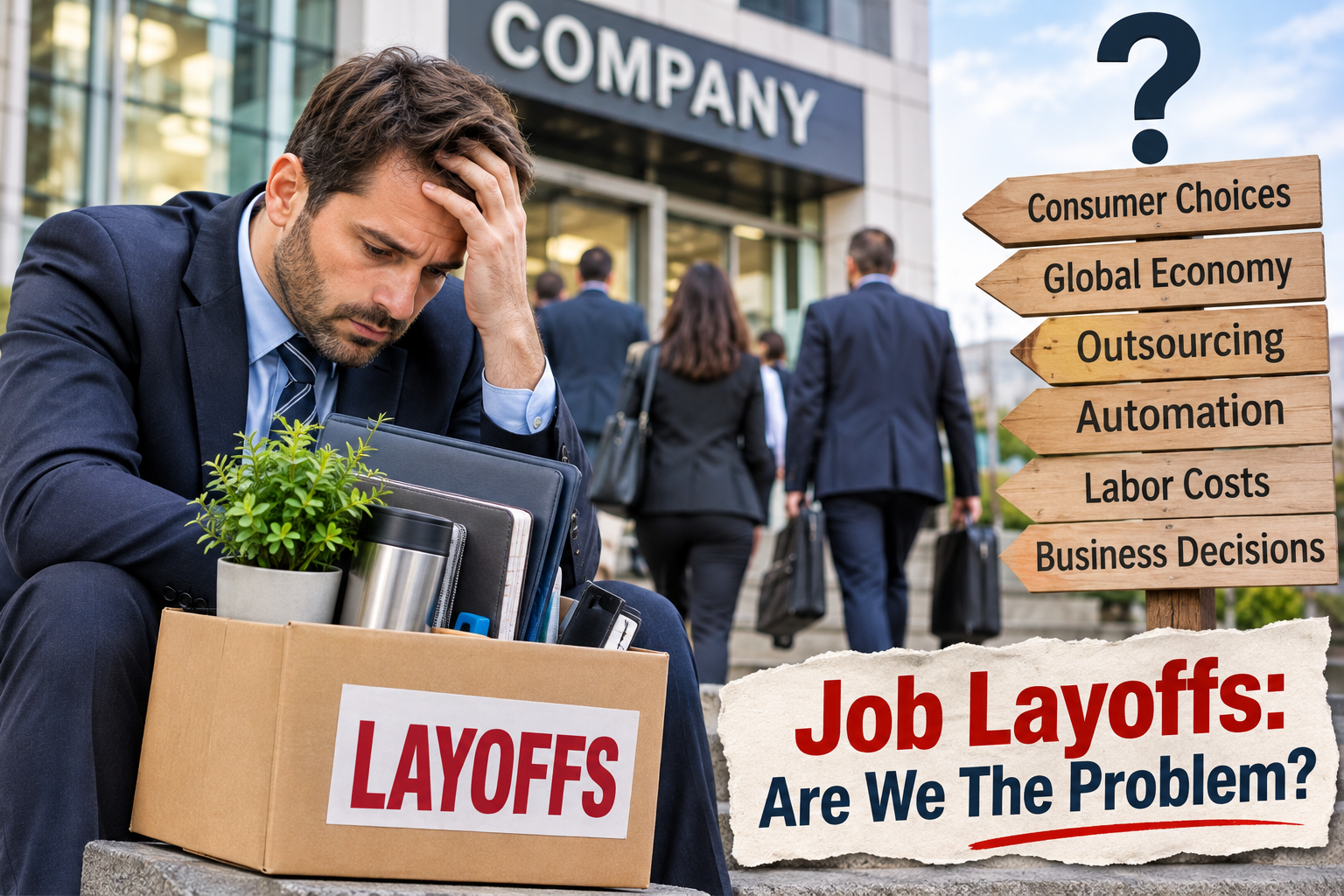
Job Layoffs: Are We Part of the Problem? Understanding the Role of Consumers, Employers, and the Global Economy

Job layoffs are among the most difficult challenges facing employees and their families. Losing a job can create financial uncertainty, disrupt long-term plans, and make people question their professional future. When companies announce layoffs, attention often turns toward employers, overseas outsourcing, automation, and government policies.
But there is another question worth considering: Do our own purchasing habits and expectations play a role in shaping the job market?
Consumers want affordable products, convenient services, and competitive prices. Businesses, meanwhile, want to reduce expenses, remain profitable, and compete with companies operating in increasingly global markets. These interests are connected, and sometimes the choices we make as consumers influence the decisions businesses make about production, staffing, and employment.
However, consumer behavior is only one part of a much larger economic picture. Understanding the relationship between shopping habits, labor costs, international trade, and job layoffs requires looking beyond simple explanations.
Why Do Companies Lay Off Employees?
Companies reduce their workforce for many different reasons. Sometimes a business is struggling financially and cannot afford to maintain its existing staffing levels. In other cases, management decides to reorganize operations, close facilities, introduce new technology, or move certain activities to another location.
Some common reasons for layoffs include:
- Financial difficulties: Falling revenue, increasing expenses, or declining demand may force a company to reduce its workforce.
- Overseas outsourcing: Businesses may move certain production or service activities to countries where operating costs are lower.
- Automation and technology: New equipment, software, and artificial intelligence can change the number and types of employees a business needs.
- Changing consumer demand: Companies may reduce production or close departments when customers stop purchasing particular products or services.
- Corporate restructuring: Mergers, acquisitions, and management decisions can result in overlapping positions being eliminated.
- Increased competition: Businesses may attempt to reduce costs to remain competitive in their industries.
It is important to recognize that layoffs are not always the result of a company’s desire to pay lower wages. Sometimes businesses are responding to declining demand, changing technology, or other pressures that affect their ability to operate.
The Consumer’s Demand for Lower Prices
Most people enjoy finding a bargain. Whether we are shopping for clothing, electronics, furniture, household products, or groceries, price is often one of the first things we consider.
When two products appear similar, many consumers choose the less expensive option. This is understandable, particularly when household budgets are under pressure.
However, there can be a connection between demand for low prices and the way businesses organize their production.
Imagine two companies selling similar household products. One manufactures its products domestically, while the other imports products manufactured in a country with lower production costs. If the imported product is significantly cheaper, the second company may attract more customers.
The domestic manufacturer may then face pressure to reduce expenses, improve efficiency, change suppliers, invest in automation, or reconsider its production arrangements.
This does not mean that every inexpensive imported product causes a domestic job loss. International trade can also create employment in transportation, distribution, retail, logistics, and other industries. Nevertheless, competition from lower-cost production can affect particular businesses, workers, and communities.
Are We Willing to Pay More for Products Made at Home?
Consider what might happen if more consumers consistently chose domestically manufactured products, even when they cost more.
Businesses could receive stronger demand for domestic production, potentially supporting investment and employment in certain industries. However, the higher production costs would not disappear. They might be reflected in the prices customers pay.
Would consumers be willing to pay extra for clothing, furniture, electronics, and other everyday products if they knew that their purchases supported domestic manufacturing?
There is no simple answer.
Some consumers are willing to pay more when products offer better quality, durability, responsible production, or local economic benefits. Others cannot afford higher prices, especially when they are already dealing with rising housing, healthcare, transportation, and food expenses.
It is therefore unrealistic to expect every household to choose more expensive products regardless of its financial circumstances.
A more useful approach is to recognize that purchasing decisions involve trade-offs. Price matters, but so do product quality, working conditions, environmental impact, supply-chain reliability, and the economic effects of production.
The Cost of Labor and Essential Services
Another important issue involves jobs that are often physically demanding, repetitive, or relatively low-paid.
Consider positions such as restaurant assistants, hotel housekeeping staff, farmworkers, construction laborers, furniture assemblers, airport ground crews, custodians, and fast-food employees.
These jobs are essential to many industries, yet they may involve demanding schedules, physical work, limited benefits, or wages that make it difficult for employees to support themselves and their families.
If employers offer higher wages, improved working conditions, predictable schedules, and better benefits, they may attract and retain more workers. However, these improvements also increase operating expenses.
Depending on the business, some of those expenses may be absorbed through lower profit margins, offset through improved productivity, or reflected in higher prices.
This is particularly relevant in industries where labor represents a significant portion of operating costs.
At the same time, higher wages do not automatically translate into higher consumer prices. Businesses have several ways to respond, and the final outcome depends on competition, productivity, demand, and the financial position of the company.
Understanding the Relationship Between Immigration and Employment
Discussions about employment sometimes focus on immigration, particularly when workers from other countries fill positions that employers have difficulty recruiting for.
However, it is important to avoid assuming that immigrant workers are responsible for job losses or that all positions filled by immigrants would otherwise be taken by domestic workers.
Labor markets are influenced by many factors, including the availability of workers, wages, qualifications, geographic location, working conditions, and employer requirements.
Some industries depend heavily on immigrant labor because of their workforce needs. Agriculture, hospitality, construction, food processing, and certain service industries are examples where immigration can be an important part of the labor supply.
Employment authorization and immigration laws also matter. Employers are responsible for following applicable labor and immigration regulations, while workers should be protected from exploitation regardless of their nationality or immigration status.
A productive discussion should focus on fair wages, legal employment practices, safe working conditions, and opportunities for workers rather than blaming one group for broader economic problems.
Are Consumers Responsible for Overseas Outsourcing?
It is tempting to argue that consumers are responsible for outsourcing because they prefer inexpensive products. There is some truth to the idea that consumer demand influences business decisions, but the relationship is more complicated.
Businesses make strategic decisions based on labor costs, transportation expenses, taxes, infrastructure, access to materials, trade regulations, production capacity, and proximity to customers.
A company may manufacture products overseas because the necessary suppliers are located there. Another may outsource customer support because it needs multilingual services across different time zones. Some companies may keep domestic production because local manufacturing provides greater quality control or faster delivery.
Consumer demand influences these decisions, but it does not determine them entirely.
It is also worth remembering that businesses are not simply passive participants in the economy. They decide how much to invest in their employees, how to organize their supply chains, and how to distribute the financial benefits of productivity.
Therefore, responsibility for employment outcomes cannot reasonably be placed on consumers alone.
What Can Consumers Do to Support Employment?
Although individual shopping decisions cannot solve every employment problem, consumers can make more informed choices.
Here are several practical ways to consider the broader impact of your purchases:
1. Look Beyond the Price Tag
Compare products based on quality, durability, repairability, and value over time. The cheapest product is not always the least expensive in the long run.
2. Consider Domestic Products
When affordable and appropriate, consider purchasing locally or domestically manufactured goods. Look for reliable information about where products are made rather than relying only on marketing labels.
3. Support Responsible Businesses
Research companies that provide fair working conditions, comply with labor regulations, and invest in employee development.
4. Buy From Local Businesses
Local shops, independent manufacturers, and small businesses can contribute to employment and economic activity in their communities.
5. Avoid Unnecessary Consumption
Buying fewer products and choosing durable items can reduce waste while helping households manage their budgets.
6. Ask Questions About Production
Consumers can encourage transparency by asking companies about their supply chains, manufacturing locations, and labor practices.
What Can Employers and Policymakers Do?
Consumers are not the only participants who can influence employment outcomes. Employers, industry leaders, and policymakers also have important responsibilities.
Businesses can invest in employee training, improve productivity, offer competitive compensation, and consider alternatives to layoffs when financially practical.
Governments can support workforce development, technical education, infrastructure investment, fair labor standards, and policies that help workers transition between industries.
Employees can also prepare for changing labor markets by developing transferable skills, learning new technologies, and remaining open to professional training.
No single solution can prevent every layoff. However, cooperation between employers, employees, consumers, educational institutions, and policymakers can help create stronger employment opportunities.
Final Thoughts: Are We Part of the Problem?
When companies announce layoffs, it is natural to ask who is responsible. Employers make staffing decisions, technology changes the nature of work, international competition influences production, and economic conditions affect demand.
Consumers also play a role because purchasing habits influence which products and businesses succeed. Our preference for lower prices can create pressure on companies to reduce expenses, although it is only one factor among many.
The important point is not to blame consumers for every job that disappears or to assume that buying domestic products will solve all employment problems. Instead, we should understand the connections between the products we purchase, the businesses we support, and the people whose work makes those products and services possible.
A stronger economy requires more than affordable shopping. It also requires productive businesses, fair employment practices, skilled workers, responsible purchasing decisions, and opportunities for people to build secure careers.
Perhaps the most useful question is not simply whether we are part of the problem, but what choices businesses, consumers, and communities can make to support a healthier and more sustainable job market.