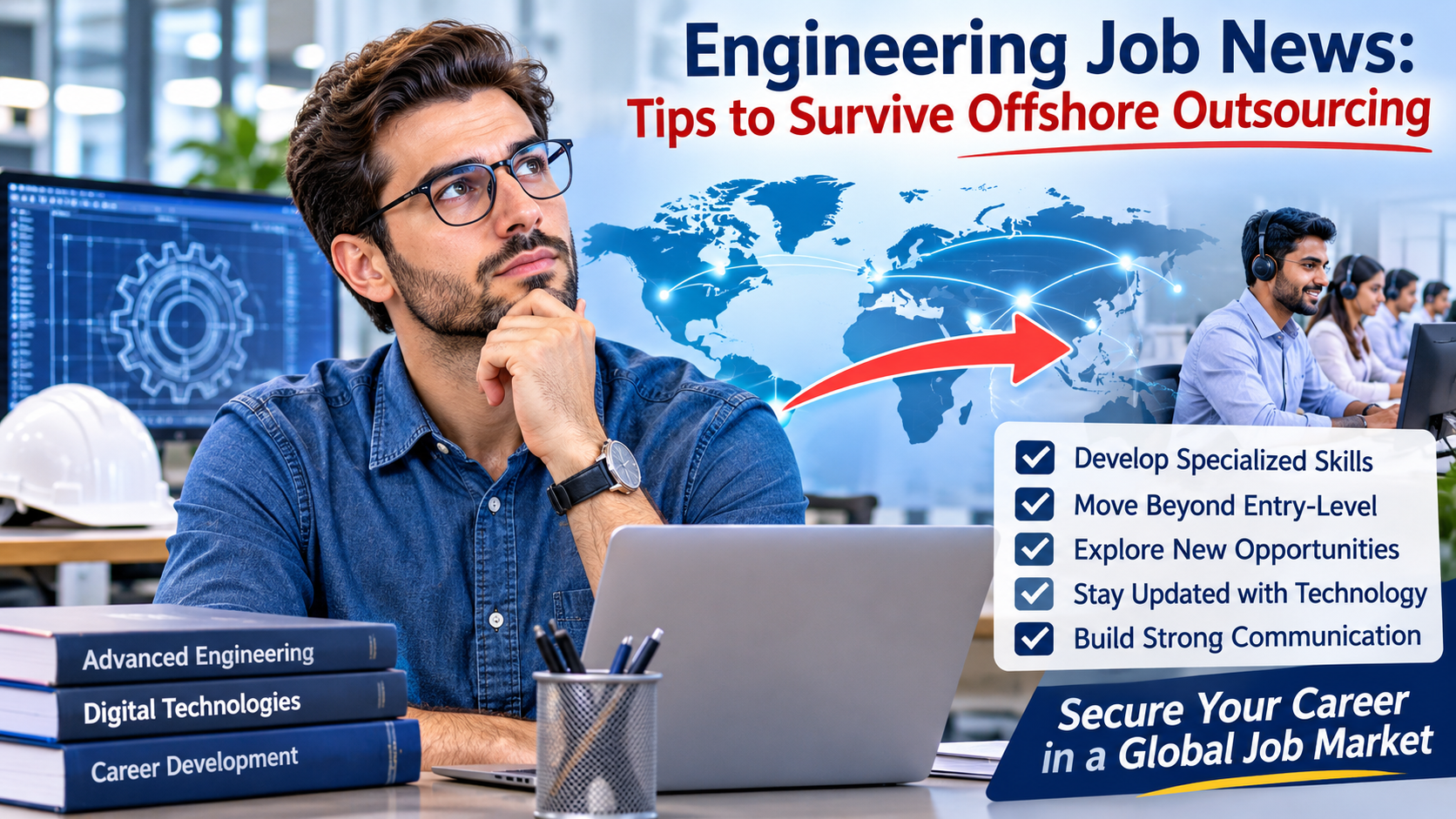
Engineering Job News: Tips to Survive Offshore Outsourcing and Protect Your Career

Offshore outsourcing has become an important part of the global business landscape. Companies in engineering, information technology, manufacturing, customer support, and other industries often work with international teams or external service providers to manage costs, access specialized expertise, and improve operational efficiency. As technology makes international collaboration easier, businesses can increasingly distribute projects and responsibilities across different countries.
For employees, however, these changes can create uncertainty. Certain routine tasks and entry-level positions may become more vulnerable to outsourcing, automation, or restructuring. Engineers and technical professionals may wonder whether their jobs are secure and what they can do to remain competitive.
The good news is that outsourcing does not eliminate the need for skilled professionals. Companies continue to need people who can solve complex problems, develop new products, manage projects, communicate with customers, and make important technical decisions. The key is to develop skills and experience that make your contribution valuable beyond repetitive, easily transferable tasks.
Here are five practical strategies to help engineering and technology professionals protect their careers and take advantage of changing employment opportunities.
1. Develop Skills That Make You Stand Out
One of the most effective ways to protect your career is to build specialized skills that distinguish you from other candidates. When several employees perform identical routine tasks, employers may find it easier to transfer those responsibilities to an external provider or automate parts of the process.
Specialized knowledge, on the other hand, can make an employee more valuable to an organization.
Consider developing expertise in areas such as:
- Advanced engineering software and specialized technical applications.
- Cybersecurity, cloud computing, and network infrastructure.
- Artificial intelligence, machine learning, and data analytics.
- Industrial automation, robotics, and control systems.
- Product development, testing, and quality assurance.
- Technical documentation and regulatory compliance.
- Project management and cross-functional coordination.
Language skills can also provide an advantage, particularly in companies that work with international clients, suppliers, and engineering teams. Being bilingual or multilingual may help you coordinate projects, understand customer requirements, and prevent communication problems.
However, technical expertise alone is not always enough. Employers also value professionals who can explain complicated concepts clearly, collaborate with different departments, and take responsibility for delivering results.
Rather than trying to become indispensable, focus on becoming adaptable, knowledgeable, and consistently useful to your organization.
2. Move Beyond Entry-Level Responsibilities
Entry-level positions are an important starting point for many engineering careers. They provide opportunities to gain practical experience, understand workplace processes, and develop technical knowledge. However, employees who remain in repetitive roles without expanding their responsibilities may face greater competition.
For example, imagine working in a department where dozens of employees perform the same basic data-entry, documentation, or technical support tasks. If these activities can be standardized, automated, or transferred to another location, the company may consider restructuring the department.
This does not mean every entry-level position will disappear. It means employees should use their early career experience as a foundation for professional development.
Look for opportunities to:
- Take responsibility for more complex assignments.
- Participate in technical planning and decision-making.
- Learn how projects are managed from beginning to completion.
- Develop leadership and supervisory skills.
- Earn relevant professional certifications.
- Volunteer for projects involving new technologies.
- Build relationships with experienced colleagues and managers.
You should also communicate your career goals with your supervisor. Ask what skills are required for more advanced positions and whether you can participate in projects that will help you develop those capabilities.
Moving into a specialized or leadership role can improve your career opportunities, although no position is completely protected from outsourcing or organizational changes.
3. Explore Smaller Companies and Specialized Businesses
Another strategy is to consider opportunities with smaller businesses, specialized engineering firms, and companies that serve particular industries or customer groups.
Large corporations may have the resources to distribute certain operations across international locations. Smaller businesses, meanwhile, sometimes depend on close customer relationships, direct communication, and employees who understand their products and services in detail.
For example, a specialized engineering company may need professionals who can visit customer facilities, inspect equipment, troubleshoot technical problems, and recommend solutions. These responsibilities may be difficult to transfer entirely to a remote external provider.
Smaller companies can also offer employees broader responsibilities. Instead of performing one narrow task, you may have opportunities to participate in product development, customer communication, technical support, and project management.
Nevertheless, company size alone does not determine job security. Small businesses can also outsource work, and some large organizations employ substantial numbers of highly specialized professionals locally.
Before changing employers, research the company’s financial stability, business model, customers, workplace culture, and opportunities for professional development. A smaller organization may offer an excellent career path, but it should be evaluated just as carefully as a large corporation.
4. Be Willing to Explore New Industries and Locations
Employment opportunities are not distributed equally across industries or geographic regions. When a particular sector experiences layoffs, outsourcing, or declining demand, professionals who can transfer their skills to other industries may have an advantage.
For example, an engineer with experience in manufacturing systems might explore opportunities in industrial automation, renewable energy, logistics, or advanced production. An IT professional with networking experience could investigate cloud infrastructure, cybersecurity, or technical consulting.
The ability to recognize transferable skills is especially important during periods of economic change.
Start by identifying the knowledge and experience you already possess. You may have developed skills in troubleshooting, quality control, project coordination, data analysis, or equipment maintenance that are useful in several industries.
You can then research sectors that are investing in new technologies or expanding their operations.
Geographic flexibility may also increase your options. Some professionals are willing to relocate to cities or regions where their expertise is in greater demand. Others explore remote work, international employment, or hybrid positions.
Before relocating, consider living costs, salary expectations, immigration requirements, professional licensing, and the long-term stability of the industry. Moving should be a carefully researched career decision rather than a reaction to temporary uncertainty.
5. Stay Ahead of Technological Developments
Technology changes rapidly, and engineering professionals who continue learning are often better prepared for changes in the workplace.
Tasks that once required significant manual effort may become automated, while new technologies create demand for different types of expertise. Artificial intelligence, robotics, advanced manufacturing, cloud computing, and digital engineering are transforming how organizations design products and deliver services.
To remain competitive, make continuous learning part of your professional routine.
You can stay informed by:
- Following reputable engineering and technology publications.
- Attending industry conferences, webinars, and professional events.
- Completing relevant online courses.
- Learning new software and technical tools.
- Participating in professional associations.
- Working on practical projects that demonstrate your abilities.
- Seeking feedback from experienced professionals.
It is also important to understand how new technologies affect your specific field. For example, an engineer working in manufacturing may benefit from learning about smart factories, predictive maintenance, and industrial automation. A software engineer may need to understand AI-assisted development, secure coding, and modern cloud platforms.
You do not need to master every emerging technology. Instead, identify developments that are relevant to your profession and focus on skills that employers are likely to need.
6. Strengthen the Skills That Are Difficult to Outsource
Technical knowledge is essential, but successful engineering professionals also rely on skills that involve judgment, communication, and collaboration.
Some responsibilities require a deep understanding of a company’s customers, internal processes, safety requirements, and business objectives. These responsibilities may be more difficult to transfer than standardized technical tasks.
Important professional skills include:
Problem-Solving: Employers value people who can identify the source of a problem, evaluate possible solutions, and make informed decisions.
Communication: Engineers must often explain technical information to clients, managers, suppliers, and colleagues who may not have the same technical background.
Leadership: The ability to coordinate teams, manage deadlines, resolve disagreements, and guide projects can create opportunities for career advancement.
Critical Thinking: Professionals who can evaluate risks, recognize limitations, and make sound decisions contribute more than those who simply follow instructions.
Adaptability: Employees who can adjust to new tools, changing priorities, and unfamiliar challenges are better prepared for workplace transitions.
These skills complement technical expertise and can help professionals move into roles involving greater responsibility.
7. Understand the Difference Between Outsourcing and Career Opportunity
Offshore outsourcing is not necessarily a threat to every engineering professional. International collaboration can also create opportunities for employees who understand how to work effectively across borders.
Many organizations use global teams to access specialized knowledge, expand into new markets, and deliver products and services more efficiently.
Professionals who can manage international projects, coordinate distributed teams, understand different business environments, and communicate across cultures may find new career opportunities in this environment.
Rather than viewing global outsourcing only as competition, consider how international business practices may create demand for project managers, technical consultants, quality specialists, cybersecurity professionals, and experienced engineers.
Understanding the global market can help you make better career decisions and identify opportunities that may not exist within your current organization.
Will Offshore Outsourcing Ever Disappear?
Offshore outsourcing is unlikely to disappear completely. As long as companies seek efficiency, access to international expertise, and competitive operating costs, many will continue working with overseas service providers.
However, the nature of outsourcing is constantly changing. Automation, artificial intelligence, cybersecurity requirements, supply-chain considerations, and customer expectations all influence which activities companies choose to perform internally and which they outsource.
For engineering and technology professionals, the most effective response is not to compete solely on salary. Instead, focus on developing expertise, gaining practical experience, improving communication skills, and learning how to solve problems that matter to employers and customers.
Final Thoughts: Take Control of Your Engineering Career
Offshore outsourcing and technological change can create challenges, but they do not have to determine your professional future. Employees who invest in their education, develop specialized skills, explore new industries, and remain open to change can improve their ability to navigate an evolving job market.
Start by evaluating your current position. Identify which parts of your work are repetitive, which skills are in demand, and what additional knowledge could help you qualify for more advanced responsibilities.
Update your resume, strengthen your professional network, research growing industries, and set realistic learning goals. Most importantly, do not wait until your position is threatened before taking action.
The engineering and technology sectors will continue to evolve. Professionals who combine technical expertise with creativity, critical thinking, communication, and adaptability will be better prepared to find opportunities and build sustainable careers in an increasingly global workplace.