
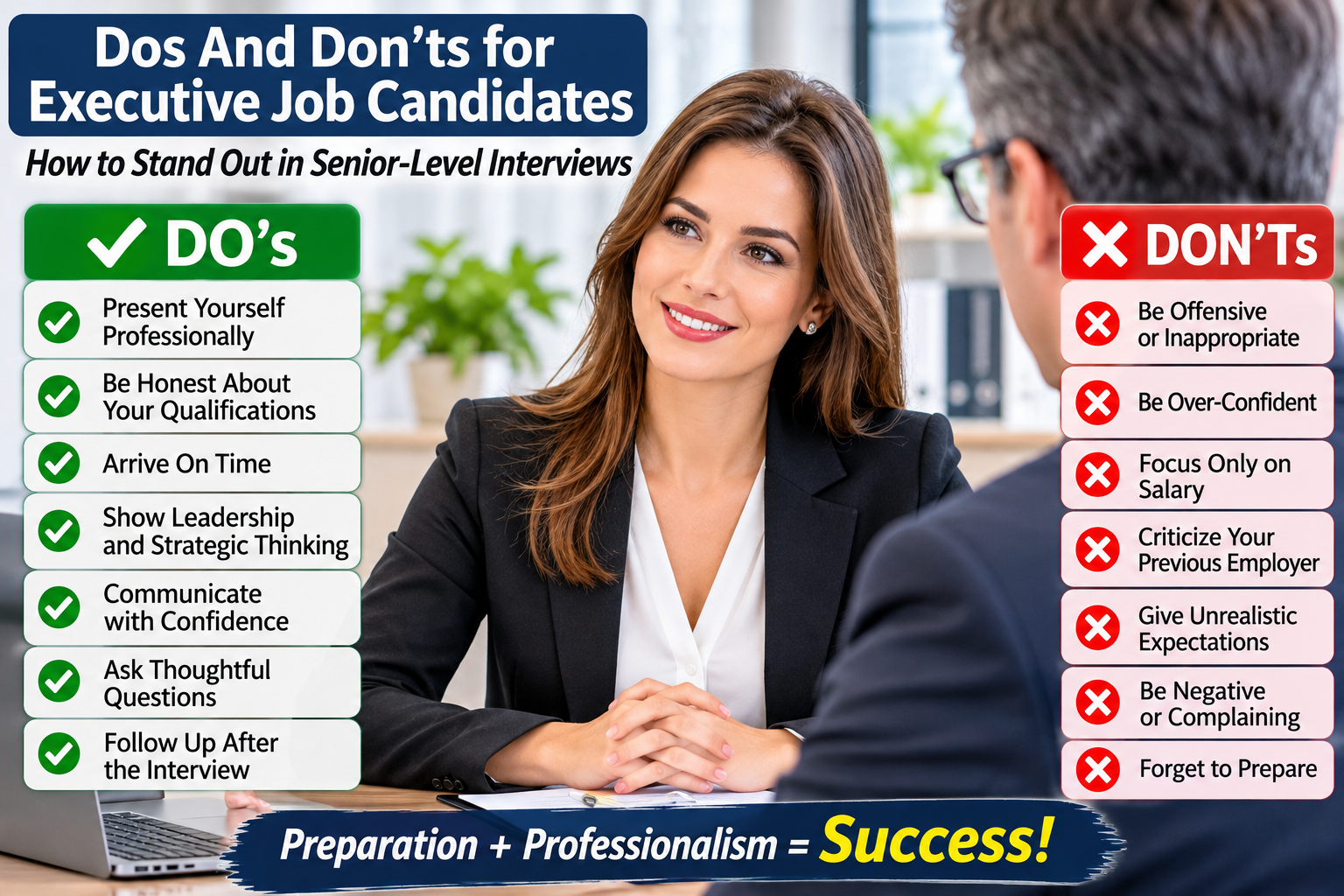
Dos and Don’ts for Executive Job Candidates: How to Stand Out in Senior-Level Interviews

Applying for an executive position is very different from applying for an entry-level or mid-level job. Senior leadership roles often involve significant responsibilities, complex decision-making, financial accountability, and the ability to influence an entire organization. Employers are not simply looking for someone with an impressive résumé. They want a candidate who can demonstrate leadership, strategic thinking, professional integrity, and the ability to deliver measurable results.
Competition for executive appointments can be intense. A strong professional background may help you secure an interview, but your communication, preparation, attitude, and ability to explain your achievements can determine whether you receive an offer.
Like every professional selection process, executive recruitment has certain unwritten rules. Understanding what to do and what to avoid can help you make a positive impression and improve your chances of securing the position you want.
DO: Present Yourself Professionally
Your professional image begins long before you enter the interview room. Every interaction with a recruitment agency, hiring manager, executive search consultant, or potential employer contributes to the impression you create.
Your résumé, cover letter, LinkedIn profile, emails, telephone conversations, and interview performance should communicate a consistent and professional message.
Make sure your résumé is clearly organized, accurately describes your experience, and highlights achievements relevant to the executive position. Rather than simply listing responsibilities, explain what you accomplished in previous roles.
For example, instead of writing that you were responsible for managing a department, describe how you improved operational efficiency, developed a team, increased revenue, reduced costs, or introduced a successful business strategy.
Your appearance also matters. Choose professional clothing appropriate for the company’s culture and the seniority of the position. During virtual interviews, pay attention to your background, lighting, camera position, and internet connection.
Professionalism does not mean being overly formal or distant. It means demonstrating confidence, respect, reliability, and good judgment throughout the recruitment process.
DO: Be Honest About Your Qualifications and Experience
Honesty is essential when applying for an executive appointment. Some candidates may feel tempted to exaggerate their qualifications, leadership experience, previous job titles, or business achievements to appear more impressive.
This approach can seriously damage your career.
Employers may verify employment history, professional qualifications, references, and other information provided during recruitment. Senior-level candidates are often subject to detailed background checks because their decisions may affect employees, customers, company finances, and business operations.
If an employer discovers that a candidate has misrepresented important information, the consequences can include losing the job opportunity or, in some circumstances, dismissal after appointment.
Present your achievements confidently, but make sure every claim is accurate. If you participated in a successful project as part of a team, explain your specific contribution rather than taking responsibility for the entire result.
You should also be comfortable discussing challenges and mistakes. Executive employers often appreciate candidates who can recognize what went wrong, explain what they learned, and demonstrate how they improved their decision-making.
Integrity is not simply a desirable personal quality. It is an important foundation of effective leadership.
DO: Arrive on Time and Be Prepared
Punctuality demonstrates respect for the interviewer’s time and reflects your ability to manage professional commitments.
For an in-person interview, plan your journey in advance and aim to arrive approximately 10 to 15 minutes early. Check the location, parking arrangements, building access, and expected travel time.
If an unexpected delay occurs, contact the company as soon as possible. Explain the situation politely, apologize, and provide an updated arrival estimate. Avoid making excuses or spending the interview complaining about traffic.
For virtual interviews, test your equipment, microphone, camera, and internet connection beforehand. Join the meeting a few minutes early and make sure you are in a quiet, professional environment.
Preparation should also include researching the organization. Understand its products or services, market position, competitors, recent developments, leadership structure, and major business challenges.
An executive candidate should be able to explain why the organization is attractive and how their experience could contribute to its future success.
DO: Demonstrate Strategic Thinking and Leadership Ability
Executive employers expect more than technical knowledge or years of experience. They want someone who can understand the bigger picture and make decisions that support long-term organizational goals.
Prepare examples that demonstrate your ability to:
- Develop and implement business strategies.
- Lead teams through organizational change.
- Manage budgets and financial responsibilities.
- Resolve complex operational problems.
- Improve productivity and organizational performance.
- Build relationships with employees, clients, and business partners.
- Identify risks and make informed decisions.
- Develop future leaders and support employee growth.
Use real examples from your professional experience. Explain the situation, the challenge you faced, the actions you took, and the results achieved.
Whenever possible, include measurable outcomes. For instance, explain how a strategy improved customer retention, reduced operating costs, increased productivity, or helped the company enter a new market.
Specific examples are usually more convincing than general statements about being a strong leader.
DO: Communicate With Confidence and Listen Carefully
Communication is one of the most important executive skills. Senior leaders regularly communicate with employees, investors, customers, board members, and other stakeholders.
During an interview, answer questions clearly and avoid unnecessary explanations. Organize your thoughts before responding, and make sure your answers directly address what the interviewer is asking.
Listening is equally important. Allow the interviewer to finish speaking before responding. If a question is unclear, politely ask for clarification rather than guessing.
You should also demonstrate that you can accept feedback and consider alternative viewpoints. Effective executives do not need to have an immediate answer to every question. They need to show that they can evaluate information, consult others, and make responsible decisions.
DON’T: Behave Inappropriately or Become Too Informal
Executive candidates are expected to demonstrate professional judgment. Being friendly and approachable is positive, but becoming overly familiar with an interviewer can create the wrong impression.
Avoid inappropriate jokes, offensive comments, excessive criticism of previous employers, and discussions that have little connection to the interview.
Be particularly careful when discussing former colleagues, managers, and business partners. Speaking negatively about people you have worked with may raise concerns about your professionalism and ability to manage workplace relationships.
You should also avoid interrupting the interviewer, dominating the conversation, or treating the interview as an opportunity to demonstrate superiority.
Respectful communication is an important characteristic of successful leadership.
DON’T: Confuse Confidence With Arrogance
Confidence is valuable in an executive interview. Employers want someone who can make difficult decisions, take responsibility, and lead others through uncertainty.
However, excessive self-confidence can easily appear as arrogance.
Avoid presenting yourself as someone who knows everything or suggesting that previous business successes were achieved entirely through your individual efforts. Most organizational achievements depend on collaboration, effective teams, and contributions from different departments.
Instead, demonstrate that you understand the importance of teamwork and recognize the abilities of others.
Explain how you motivate employees, encourage new ideas, manage disagreements, and create an environment where people can perform at their best.
A strong executive knows how to lead with confidence while remaining open to feedback, learning, and improvement.
DON’T: Focus Entirely on Salary and Benefits
Salary is an important consideration when accepting an executive appointment. Senior positions often involve complex compensation packages, performance bonuses, retirement benefits, company vehicles, equity arrangements, and other incentives.
However, making compensation the main subject of your first conversation can give the impression that financial rewards are your only motivation.
During the early stages of the interview, concentrate on understanding the organization, the position, its responsibilities, and the expectations of the employer.
When the conversation naturally moves toward compensation, discuss your expectations professionally. Consider the complete package rather than focusing only on the basic salary.
You should also research typical compensation levels for similar positions in the relevant industry and location. This helps you negotiate realistically and explain why your experience and responsibilities justify your expectations.
Negotiating confidently is appropriate. Making unrealistic demands without demonstrating your value is not.
DON’T: Criticize Your Previous Employer
You may have left your previous organization because of disagreements, poor management, limited career opportunities, or organizational changes. These experiences can be difficult, but an executive interview is not the right place to express personal frustration.
Avoid making negative comments about former employers, colleagues, or business partners.
If you are asked why you left a previous position, provide a balanced and professional explanation. You might discuss your interest in new challenges, opportunities for strategic development, or the desire to take on broader responsibilities.
If you experienced a difficult workplace situation, focus on what you learned and how you handled it constructively.
Employers want to know that you can manage sensitive situations without allowing personal disagreements to interfere with professional responsibilities.
DO: Ask Thoughtful Questions
An executive interview should be a two-way conversation. You are evaluating the organization just as carefully as the employer is evaluating you.
Prepare thoughtful questions that demonstrate your understanding of leadership and business priorities.
For example, you could ask:
- What are the organization’s most important strategic priorities over the next two years?
- What challenges would the successful candidate need to address first?
- How will success in this position be measured?
- What is the company’s approach to leadership development and organizational culture?
- How does the executive team work together when making major business decisions?
- What opportunities exist for innovation and long-term growth?
These questions help you understand the role while demonstrating that you are thinking beyond the immediate job offer.
DO: Follow Up After the Interview
Your professional communication should not end when the interview finishes.
Sending a brief thank-you email within 24 hours is a useful way to express appreciation and reinforce your interest in the opportunity.
Mention something specific from the discussion, such as a business challenge, organizational goal, or responsibility that made the position particularly interesting.
Keep your message professional and concise. Avoid sending repeated messages asking for an immediate decision unless the employer has provided a reason to follow up.
If the interviewer gives you a specific timeline, respect it. If that deadline passes without an update, a polite follow-up is appropriate.
Prepare for Common Executive Interview Questions
Executive interviews often include questions that explore leadership style, strategic thinking, decision-making, and professional achievements.
Consider preparing answers to questions such as:
- How would you describe your leadership style?
- What is the most significant business achievement in your career?
- Tell us about a difficult decision you had to make.
- How do you manage conflict between senior team members?
- How would you improve our organization’s performance?
- Describe a time when a business strategy did not produce the expected results.
- How do you identify and develop future leaders?
- What would your priorities be during your first 90 days in this position?
Avoid memorizing answers word for word. Instead, prepare relevant examples and practice explaining them naturally. Your responses should demonstrate sound judgment, accountability, and an understanding of the organization’s needs.
Final Thoughts: Preparation Makes the Difference
Executive appointments carry significant responsibility. Employers are looking for candidates who combine professional experience with leadership ability, integrity, strategic thinking, and effective communication.
A polished résumé may help you secure an interview, but your behavior and preparation will influence the impression you leave behind.
Present yourself professionally, tell the truth, arrive on time, and demonstrate the value you can bring to the organization. Avoid arrogance, inappropriate behavior, excessive salary discussions, and negative comments about previous employers.
Most importantly, remember that an executive interview is not simply about convincing an employer to hire you. It is also an opportunity to determine whether the organization, its leadership culture, and its strategic direction are right for your next career move.
With careful preparation and a balanced professional attitude, you can approach executive interviews with greater confidence and improve your chances of finding a leadership position that matches your experience and ambitions.