Quick Resume Writing Tips: How to Evaluate and Improve Your Resume

Writing a strong resume can be challenging, and many job seekers feel relieved once they have finished putting their work history, education, and skills on paper. However, completing a resume is only the first step. Before submitting it to an employer, take the time to review it carefully and identify areas that could be improved.
Your resume is an important marketing tool. It introduces you to potential employers and helps them understand your qualifications, experience, and professional strengths. A well-written resume can encourage a recruiter to invite you for an interview, while a poorly organized or irrelevant resume may be overlooked. Even highly qualified candidates can miss opportunities if their resumes fail to communicate their value clearly.
The good news is that evaluating your resume does not have to be complicated. By following a practical checklist, you can identify weaknesses, improve readability, and make sure your resume presents you as a strong candidate for the position you want.
1. Review the Overall Appearance of Your Resume
Before examining individual sections, look at your resume as a whole. Does it appear organized, professional, and easy to read? Employers often review many applications, so a clear layout can help them find important information quickly.
Use consistent formatting, readable fonts, clear headings, and enough white space to prevent the page from looking crowded. Avoid excessive colors, decorative graphics, and complicated layouts that may distract from your qualifications or make your resume difficult for applicant tracking systems (ATS) to process.
Pay attention to length as well. Students and recent graduates can often present their qualifications on one page, while experienced professionals may need two pages to describe relevant achievements. There is no universal page limit, however; the goal is to include useful information without unnecessary repetition.
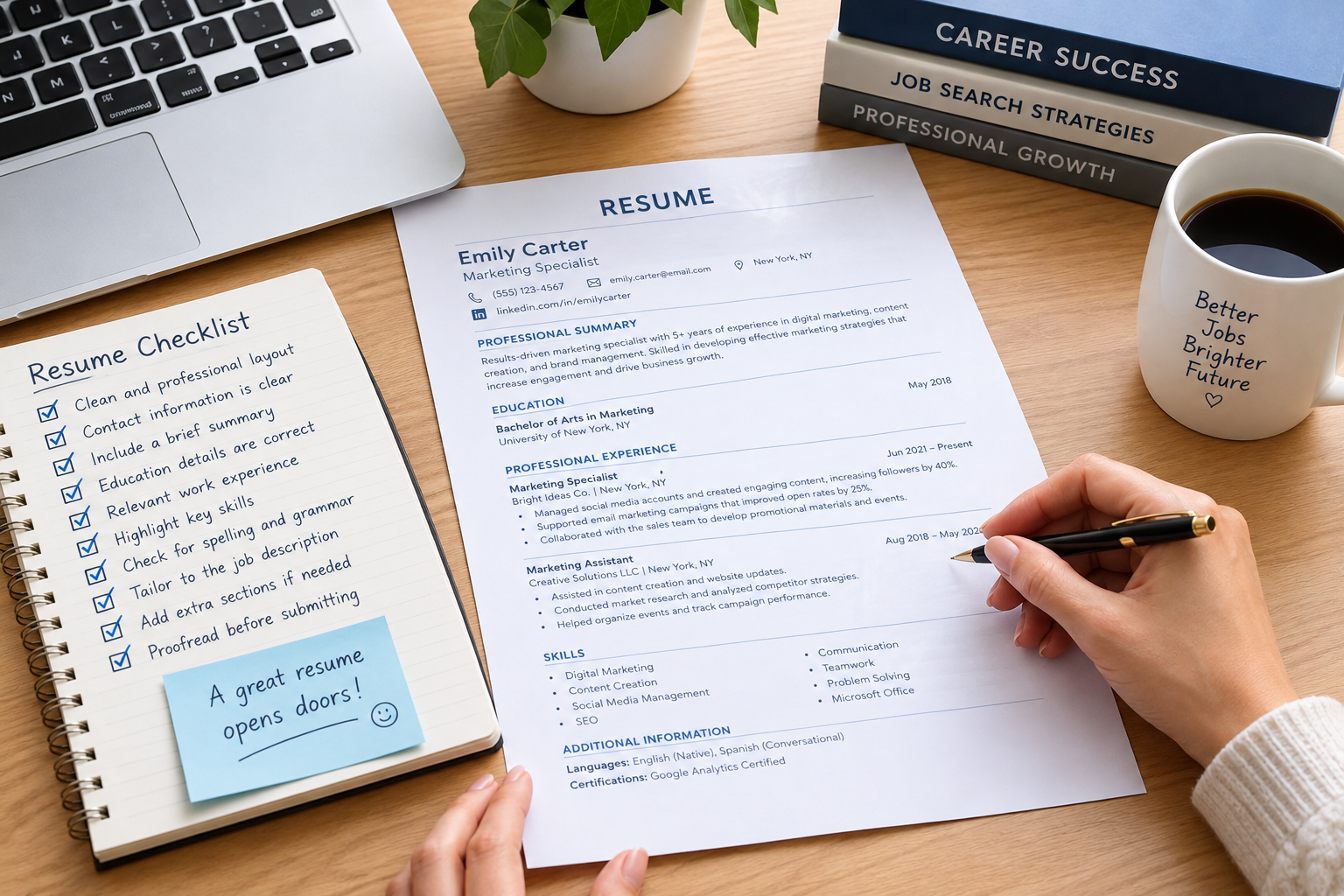
Before submitting your resume, ask yourself:
- Is the layout clean, consistent, and easy to scan?
- Are the fonts readable and professional?
- Have I corrected spelling, punctuation, and grammatical errors?
- Has another person reviewed the document?
- Does the resume highlight my most relevant qualifications?
- Is the content tailored to the position I want?
- Does the document create a positive and accurate impression of me?
Your resume should communicate your value within a short period of time. Every section should contribute to that goal.
2. Check Your Contact Information and Introduction
Your name and contact information should be easy to locate, usually near the top of the first page. Include a professional email address and a phone number where employers can reach you. You may also include your city or region and a link to a relevant professional profile or portfolio.
You generally do not need to provide sensitive personal information, such as your national identification number, marital status, or full home address, unless a legitimate application requirement specifically calls for it.
Consider adding a short professional summary when it helps explain your experience and strengths. For example, an experienced project coordinator might highlight project planning, team communication, and successful delivery. A recent graduate could emphasize relevant coursework, internships, technical skills, and career interests.
A summary should be specific rather than filled with generic statements. Avoid phrases such as “I am a hardworking person” unless you can support them with concrete examples.
3. Evaluate Your Career Objective or Professional Summary
A traditional resume objective is optional. In many cases, a focused professional summary or a clearly organized skills section is more useful, particularly for experienced applicants.
If you choose to include an objective, keep it concise and relevant to the job. Explain what kind of opportunity you are seeking and, where appropriate, what you can contribute to the employer.
For example, instead of writing, “I want a challenging job where I can grow,” consider a more focused statement:
“Seeking an entry-level marketing position where I can apply my content creation, research, and digital communication skills to support business growth.”
The revised statement communicates a clear direction and identifies relevant strengths. Whatever format you choose, make sure the introduction supports the rest of your resume rather than repeating information without adding value.
4. Make Your Education Section Clear
Your education section should accurately communicate your academic background. Recent graduates may place education near the top of their resumes, especially when their degrees or coursework are relevant to the job. Experienced professionals will often benefit from placing work experience first.
Include the institution’s name, degree or qualification, field of study, and graduation date when appropriate. You can also mention relevant academic projects, certifications, honors, or coursework if they strengthen your application.
If you have not completed a degree, describe your education honestly. You can list the institution, field of study, and expected graduation date if applicable. Never imply that you earned a qualification you did not complete.
The goal is to help employers understand your educational background without making them search for essential details.
5. Strengthen Your Professional Experience Section
Your work experience is often one of the most important parts of your resume. Present positions in reverse chronological order, starting with your most recent role, unless a different structure is more appropriate for your situation.
For each position, clearly identify the employer, job title, dates of employment, and key responsibilities or achievements. Use bullet points to make the information easier to scan.
Whenever possible, emphasize results rather than simply listing duties. For example:
- Instead of “Responsible for customer service,” write “Resolved customer inquiries and helped improve response times.”
- Instead of “Managed social media,” write “Created and scheduled social media content to increase audience engagement.”
- Instead of “Worked on sales,” write “Supported sales activities by following up with prospects and maintaining customer records.”
Use numbers when you can support them accurately, such as the size of a team you supervised, the number of projects you completed, or a measurable improvement you contributed to.
You do not necessarily need to list every job you have ever held. Prioritize relevant experience, but include earlier positions when they demonstrate important transferable skills or help explain your career history. If there are gaps in your employment, represent your dates honestly and be prepared to explain your circumstances if asked.
6. Tailor Your Skills to the Job Description
A skills section can help employers quickly identify whether your qualifications match their needs. Review the job description and identify the technical abilities, software knowledge, industry expertise, and interpersonal skills relevant to the role.
For example, an administrative position may require scheduling, recordkeeping, spreadsheet skills, and communication. A software development role may prioritize programming languages, development tools, and technical problem-solving.
Include only skills you genuinely possess and can discuss confidently during an interview. Avoid adding keywords simply because they appear in a job advertisement. If you claim proficiency in a particular tool or technique, be prepared to provide an example of how you have used it.
Where possible, demonstrate important skills in your professional experience section rather than relying entirely on a list. Evidence makes your qualifications more convincing.
7. Decide Which Additional Sections to Include
Additional sections can strengthen your resume when they provide relevant evidence of your abilities. Depending on your background and the position, useful additions may include:
- Certifications and licenses: Relevant professional qualifications or industry credentials.
- Projects: Academic, personal, or professional work that demonstrates practical ability.
- Volunteer experience: Activities that show leadership, teamwork, organization, or community involvement.
- Technical skills: Software, tools, systems, or specialized methods relevant to the role.
- Languages: Languages you can use professionally, with an accurate indication of proficiency.
- Professional achievements: Awards, publications, presentations, or measurable accomplishments.
Avoid adding sections merely to make your resume longer. Each detail should help an employer understand why you may be a suitable candidate.
8. Proofread and Test Your Final Resume
Before sending your application, read the entire document slowly. Spell-checking software can catch many mistakes, but it may not identify incorrect word choices, awkward sentences, or inconsistent dates.
Ask a trusted person to review your resume with fresh eyes. You can also compare it with the job advertisement to confirm that your most relevant qualifications are easy to find.
Finally, save your resume in the format requested by the employer. A PDF is often suitable when the application instructions allow it, while some online systems specifically request a Word document. Use a professional file name, such as “Alex_Morgan_Resume.pdf,” rather than a vague label like “finalversion2.”
Give Your Resume a Final Review
A strong resume is clear, accurate, relevant, and easy to navigate. It does not need elaborate design or exaggerated claims to stand out. Instead, it should show employers how your experience, education, skills, and achievements relate to the position they are trying to fill.
Reviewing your resume before every application can help you identify weaknesses, remove unnecessary details, and present your qualifications more effectively. With careful editing and a targeted approach, you can create a professional document that supports your job search and helps you take the next step toward an interview.
Before submitting your next application, take a few minutes to evaluate your resume. A small improvement could make a meaningful difference in how employers understand your professional value.